The text for this guide is taken from The Church of St John the Evangelist, Corby, Lincolnshire, and its Mural Paintings by E Clive Rouse, FSA (printed for private circulation by Strangeways Press Limited, London, 1941).
The work of uncovering and preserving the mural paintings in the Church of St John the Evangelist, Corby, was undertaken and the description of them in this book was written as a gift to the Church and to serve as a memorial to Sir Frederick Jones, Bart. of Irnham Hall.
The structure
Form; Materials
The church consists of chancel with North chapel, clerestoried nave of four bays with North and South aisles, West tower, and South porch with chamber over. The walls are built mainly of limestone rubble quarried locally, with dressings and occasional facing of Ancaster stone. The nave arcades and South porch are of Ancaster stone; and some of the weatherings are of Clipsham stone. In the South aisle exceptionally large blocks are used. The roofs of chancel, nave and tower are covered with lead; those of the aisles with slate.
Features of special interest
The building is a large and important one, but lacks the fine detail and fittings found in many structures of this area. It shows an interesting development of its plan from the 12th century onwards. The nave and clerestory are lofty and well-proportioned, and the South porch with its upper chamber is good work. The outstanding feature of the building is the extensive set of mural paintings discovered in 1939–40. There is a good series of masons’ marks.
Development
12th century
There was a church on the site in the 12th century, probably consisting of an aisleless nave and chancel, the nave about the same dimensions as at present, the chancel shorter. The jambs and imposts of the chancel arch are of 12th-century date, reset and widened when the existing pointed chancel arch of two chamfered orders was inserted, probably in the late 13th or early 14th century. Straight joints in the south-east, north-west and south-west corners of the nave show the extent of the 12th-century work. High up under the roof in the west corner of the south aisle are remains of the original Norman external table.
13th century
Little evidence remains of work in the 13th century. As stated above, the Norman chancel arch was probably replaced towards the end of the 13th or very early in the succeeding century. The window in the gable above the chancel arch, the jambs of which were discovered in the recent repairs [in 1939–40], was also probably of this period. The font is of late 12th- or early 13th-century date, restored.
14th century
Early in the 14th century the north aisle was certainly built and the Altar there dedicated to the Virgin before 1319 (see the will of Dame Margery de Crioll [Kyriel] referred to later). The north door and the two windows, one with geometrical tracery and the other with plain intersecting tracery as at Grantham and Great Gonerby, are good examples of the period. The south aisle was also probably built at this time, as there is evidence of an early doorway with the outline of another porch with no upper story and a steep-pitched roof. Moreover, the piscina in this aisle is of early 14th-century date, but may not be in situ. The base of the tower, judging by the stonework and the ogee head of the stairway door, also probably comes within this period.
15th century and later
The succeeding century saw great changes. At the opening of the century the whole of the nave arcades were rebuilt, the steep-pitched roof removed (its line is marked by two cracks above the chancel arch) and the clerestory added. The two arch and all the windows in the south aisle were inserted at the same time, and the south porch was rebuilt and a parvise and stairway added. A little later and with slightly different detail the north aisle was extended eastwards and the north wall of the chancel pierced to form a chapel, the north wall of the aisle being heightened to take the new and flatter-pitched roof (the join can be seen externally). The upper part of the tower with battlements and panelled cornice was remodelled. Later still, the tracery of the east window of the chancel was inserted in the older arch.
Restorations
The church underwent considerable restoration in 1860, when the south wall of the chancel was practically rebuilt and modern piscina and sedilia inserted. Later in the century the roofs were renewed with poor detail and material. In 1926 the tower was restored, and in 1934–5 the nave roof was releaded and other work done. The interior was redecorated in 1939–40, resulting in the discovery of the mural paintings and other features.
The fittings
Among the fittings, the remains of old glass, the altar rails, one of the chests, and the piscina in the south aisle are of particular interest.
Altar rails
Of oak, with moulded rail and turned balusters on square bases and caps. Mid-17th century.
Bells
Four [in 1940]. The oldest is No. 3, dated 1604, and is inscribed: “I sweetly tolling men to call To taste on meats that feed the soule.” No. 1 was given in 1618 and is inscribed “Merorem mestis, letis sic leta sonabo” (I will sound sadness to the sad, joys to the joyful). No. 2, 1629, is inscribed “Non clamor sed amor cantat in aure Dei” (Not noise but love sounds in the ear of God). No. 4, 1670, is inscribed “In nomine Jesu Christi omne genu flectatur, coelestium, terrestrium et inferiorium” (At the name of Jesus every knee shall bow, etc.). These are all from the foundry of Henry Oldfield. For further details see North’s “Lincolnshire Bells” and “A History of the Parishes of Irnham and Corby” by the Rev. A. Abbott.
The bell frame
Of fine oak beams, has the following inscription deeply cut on one beam: T.T. (S.A) R.K L.H. C.-W. 1670. (Thomas Troope was Vicar at the time and the other initials are those of the Churchwardens.)
Brasses and Indents
(1) Small square brass plate in the north chapel to John Wade, 1795.
(2) and (3) Two slabs between chancel and north chapel, one having indents of man and wife with inscription beneath, ? two groups of children, and four shields of arms in the corners: probably late 15th century. The other has indents of man and wife, inscription beneath, and scrolls above; four shields in the corners and three curious indents in the centre: also 15th century, but earlier than the other.
Chests
Two. One, possibly early 16th century, is of oak, bound with iron and has two elaborate lock plates with escutcheons and clasps. Slits have later been made in the top for use as an alms-chest. The other, late 17th century, is of oak with panelled front. [stolen]
Clock
The Terrier of 1708 mentions “a clock in ye steeple”: parts of its mechanism remain in the tower. [2026: now in the room above the porch]
Coffin stools
A pair, of plain oak with lightly moulded legs and plain stretchers: 17th century.
Font
Plain square bowl with broach-stop corners, late 12th or early 13th century, retooled and set on modern shafts and base as a memorial to James and Eliza Tinkler in 1893.
Glass
There are some fragmentary remains of ancient glass, a sad relic of that listed by Gervase Holles as being in the church in 1640. In the tracery lights of the windows of the north aisle is some contemporary glazing (early 14th century) consisting of roundels, foliage and shields of arms, those of Pecche (Ar. a fess between 2 chevrons gu.) being identifiable, and another being a difference of the same, the fess and the chevron being sable.
In the middle window is a crowned and nimbed head of the Virgin apparently from a Pieta or Entombment to judge by the attitude and sad and downcast eyes: 15th century. The head of Christ next it is modern, but the nimbus is 15th century.
In the curious little quatrefoil light west of the north door is a charming figure of the patron saint of the church, St John the Evangelist, holding a palm. It is of 15th-century date and is stated to have been removed from the east window of the south aisle. The use of the palm as a symbol, without the Eagle or Chalice, is unusual.
In the head of the west window of the south aisle are fragments of canopy-work and pinnacles. In the heads of two of the south windows are some roundel fragments, all 15th century.
Monuments and floor slabs
The church is peculiarly devoid of memorials of any age or interest. In the north chapel is an oval tablet with shield of arms and Latin inscription to Francis Wilcox, Master of the Grammar School, and Vicar of Bitchfield, died 1776. On the west wall of the nave and the west respond of the north arcade are two more tablets of heavy but pleasing local workmanship to Robert Kirke, 1776, and to Mary, his wife. Anne Wade’s monument in the north chapel is by Hawley of Colsterworth.
Much of the flooring is made up of ancient tomb-slabs either plain or with initials only. The early Victorian Gothic tablet, by Botherway of Grantham, to John Hutchin, Master of the Grammar School, Rector of Faldingworth and Harston, and Chaplain to the Duke of Rutland, is an interesting period piece.
Niches, recesses, etc.
In north wall of north aisle, small image niche with trefoiled, ogee head, mutilated, with original colouring. This was discovered when work on the paintings was in progress.
In north chapel, shallow tomb-recess with plain arch of one square order and imposts, probably 13th or 14th century reset.
Paintings
A remarkable series discovered in 1939–40 covering nave and north aisle, and fragments in the south aisle, ranging in date from 1300 to post-Reformation texts. Described in detail in the succeeding section.
Piscina
In south aisle, double, with elaborately carved head having buttresses, canopies and finials with traces of colouring. Early 14th century, possibly reset.
Plate
Chalice, of silver, inscribed, “I am for Corby in Lincolnshire”: late 17th century.
Roofs
Chancel, modern. Nave, of unusually flat pitch, retains some old tie-beams and other timber, but the wall brackets are boxed in and the braces and other details are modern. The south aisle roof is good early 16th-century work, panelled and with moulded members, restored. The north aisle roof has been altered at several periods and modernised, the intermediate wall brackets being removed and the plaster filling of the compartments replaced by varnished matchboarding. All the corbels in the aisles are modern.
Table
In the north aisle, Communion table of oak, with turned baluster legs and moulded stretchers: probably late 17th century, but much restored. [no longer there]
Miscellanea
Corbels and brackets
In the north chapel (now vestry) large plain corbel to hold the image of the Virgin formerly in niche in north aisle. In south aisle east of south door, two corbels, found in the restoration of the church, one from entrance from north aisle into north chapel, and one from north chapel roof retaining traces of colour: 15th century. The series of corbels supporting the nave roof brackets is good. The work is well carved in stone, of early 15th century date, and the subjects are grotesque beasts and figures. It is curious that the westernmost corbel on the south side is of oak, and represents a man’s head in a mail coif. It would appear by its style to have come from an earlier roof.
Entrance of stairway on to rood loft in north-east angle of nave: lower entrance blocked.
Scratch dials
There is a good series of scratch or mass dials. (1) In stone, reset upside-down, on north-east side of chancel arch, interior. (2) On east side of entrance to south porch. (3) Beside centre window of south aisle. (4) In rebuilt buttress of chancel.
Stone mouldings
Three fragments discovered in recent work [in 1939–40].
Doors to parvise
both 15th century, of oak battens with decorated lock plates.
Squint
Remains of elevation squint, now blocked, in north wall of chancel before wall was pierced to make north chapel.
Tiles
Two encaustic tiles, one with yellow and one with dark brown glaze: late 14th century.
Masons’ marks
There is an interesting and extensive series of masons’ marks, showing that five or six men were employed in the 15th-century rebuilding. The principal or master mason, who used a long arrow as his mark, seems to have been engaged on the tower and nave arcades only; the others are found scattered about in the clerestory and elsewhere in the nave.
The Registers
The Registers date from 1564 and there is a List of Vicars from 1220.
The mural paintings
The discovery
In 1939 the Vicar, the Rev. Harold S. Goodrich, decided to have the interior of the church cleaned and redecorated. Before all this work was done, the architect in charge of the work, Mr Lawrence H. Bond of Grantham, wisely decided to have the walls inspected in case the plaster was medieval and retained any traces of painting. I [Clive Rowse] was called in to undertake this, and on making tests evidence of very extensive mural decoration immediately came to light. Sir Walter Benton Jones, Bart., on being approached by the Vicar, most generously undertook to have all the paintings uncovered and treated, and I was entrusted with the task, which occupied over six months. As a result, Corby church now exhibits the finest examples of medieval painting in Lincolnshire, and the discovery is the most important and extensive made in England in recent years.
Of church paintings in general
The church walls provide impressive proof of the fact that every medieval church was formerly completely painted, the subject-matter being mainly directed towards teaching the illiterate congregation by means of pictures easily understood. As these paintings became dilapidated, or structural alterations were made to the building, so they were repainted or replaced at several times during the medieval period. Eventually, all these subjects were deliberately defaced at the Reformation as being Popish, and were in most cases covered with whitewash on which texts in frames were painted. Several examples of these latter remain. They in turn became dilapidated or unfashionable and were covered by successive coats of limewash until not the slightest trace of painting of any period was visible.
The Corby paintings
At Corby the paintings are of two periods, with post-Reformation texts of two dates. Two of the subjects are of great rarity – the Virgin protecting souls under her cloak; and the Warning to Swearers – and a third, the great Nativity series in the nave, is treated in a most unusual and interesting way. The whole set is a fine example of medieval art and teaching.
Treatment and condition
It may be stated that the drawings here reproduced were all made to scale while the paintings were under treatment. In those cases where the paintings are palimpsest, the two periods have been drawn separately for the sake of clarity.
It should be clearly understood that no attempt at “restoration” has been made: the paintings are merely cleaned, treated to bring up the colour, and fixed. The condition of many is fragmentary, not solely due to their defacing in the 16th century, but largely due to failure of the plaster base. This can be traced partly to neglect of the structure in the past – dampness of walls caused by earth piled up at the base, failure to clear pipes and gutters, and to attend to roofs and pointing – and partly to the use of a poor natural mortar in the walls and plaster itself. Very heavy plaster repairs were everywhere necessary; and these patches have been toned down so as not to distract the eye.
The north aisle
Development of the north aisle and its two series of paintings
In the north aisle there are two distinct series of paintings separated by about a century in date.
As stated above, the aisle was built as a Lady chapel before 1319 by Dame Margery de Crioll, for he will, at Lincoln, bearing that date, leaves bequests to the Priests “… in the chapel of Our Lady which I have built in Corby Church”. A scheme of mural painting evidently accompanied this work and two subjects remain.
About 1400 or soon after, the aisle was lengthened, forming
a chapel on the north of the chancel where the Lady Altar was transferred: the aisle wall at the same time raised, as may be seen on the outside, to accommodate the new roof of flatter pitch. This meant that the existing paintings on the north wall were damaged. The medieval decorators did not attempt to restore them, but decided on a completely new scheme. They covered what was left of the old subjects with a thin wash of lime-putty, and repainted the whole wall with two new subjects, only repeating the St Christopher in a fresh position farther west.
The early subjects
St Anne and the Virgin
Of the early 14th century paintings, the first is found immediately east of the north door. It is an exquisite representation (above life-size) of St Anne teaching the Virgin. The work is almost in outline with faint shading of the draperies in blue-black, and a sparing but effective use of colour. The features and hair are drawn in red and the saint’s nimbus and morse and the jewels on the girdle are in green, a rare and expensive colour which is also used for the Virgin’s robe. The book that the Virgin was holding has perished. The two figures, delicately and gracefully posed, stand on a dado of quatrefoils (Plate I).
St Christopher I
East of the first window are the remains of a second early subject now much confused by lying partly beneath a later painting which could not be removed on account of its interest. It is an enormous representation of St Christopher carrying the Holy Child, in its usual position opposite the main (south) entrance. The rebuilding of the upper part of the wall has destroyed the heads of both the Saint and of the Christ, and the base was damaged by the insertion of a mural tablet (now moved elsewhere) and the failure of the plaster due to damp. However, the painting exhibits several remarkable features (Plate II).
The Saint is clad in a pink cloak lined with green, the double drapery folds falling from his left arm. He grasps his staff of green outlined in black in his right hand, leaning on it, while the knees are bent in the effort of forging across the stream, a tiny fragment only of which in grey-green with black lines is preserved at the base. The Saint’s figure is immense, being about nine feet high.
The Child is held on the Saint’s left shoulder. He has bare feet and is clad in a most remarkable peacock robe with elaborate neck- and hem-edgings and belt. His right hand is raised in blessing and his left grasps the lower part of the orb, in black outline with wavy green and yellow bands.
The pose of the whole composition is graphic and vigorous.
It will be noticed how this painting is set out to the left-hand side of the wall, and not in the centre between the two windows, in order to balance the little niche on the right, outlined in red, yellow and black.
The second series
After the structural alterations described above, a new scheme of painting was undertaken in the aisle, about 1400 or soon after, to judge by the costume.
The weighing of souls
The first of the subjects in this series occurs at the west end, partly above the north door and the quatrefoil window. It represents the Weighing of Souls by St Michael, with the Virgin interceding – a literal expression of the idea of one’s good deeds being weighed against one’s bad at the last day, and the Compassion of Our Lady (Plate III).
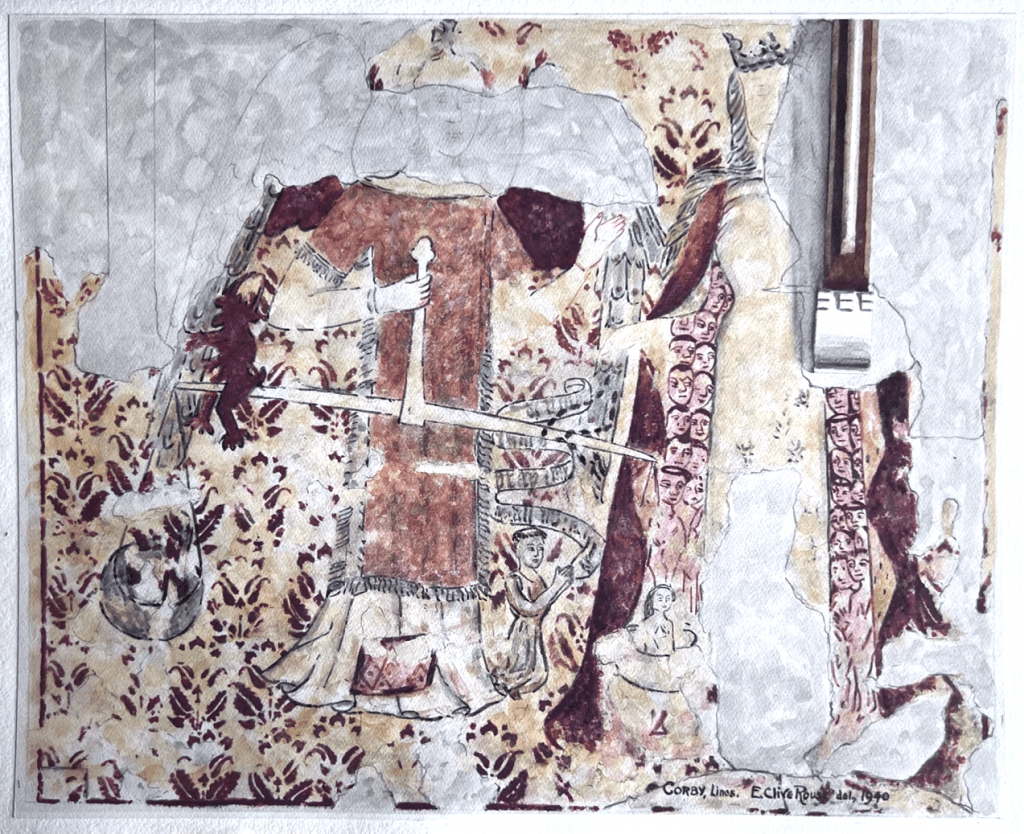
The composition, though damaged by plaster failures and the insertion of later roof brackets, is striking. St Michael, in apparelled and fringed vestments, stands in the centre (the face and upper part of the wings are destroyed) holding a large balance. A small devil sits astride the west end endeavouring to push the scale down, and so gain the soul faintly visible in the other pan. But the Virgin, a graceful figure as tall as St Michael, but mutilated by the roof bracket, places the beads of her rosary on the other end of the beam, thus tilting the scale in favour of the soul.
The interesting and unique point about the composition is that Our Lady is seen at the same time protecting souls, grouped in pairs, under the folds of her cloak. This is a common feature on the Continent, but is the only surviving example in this country.
At the foot of St Michael kneels the small figure of a priest being presented to the Virgin and having above him a scroll inscribed in English. It probably represents the donor of the painting, most likely the Vicar of the time. The whole composition has an elaborate brocade-pattern background in deep red, painted with a stencil.
St Christopher II
Adjoining this subject, on the next section of walling eastwards, are the fragmentary remains of a second painting of St Christopher (Plate IV). As already stated, the early St Christopher was mutilated during the structural alterations c. 1400 and was covered by another painting. On account of the Saint’s universal popularity as Patron Saint of travellers and as a talisman against sudden death, the subject had to be accommodated somewhere; and so it was painted again over the early rendering of St Anne and the Virgin. The lower part was very fragmentary and was removed to expose the exquisite earlier subject. The top, however, on the newer plaster is fairly complete. An intermediate roof-bracket (removed) unhappily came in the centre of the Saint’s face.
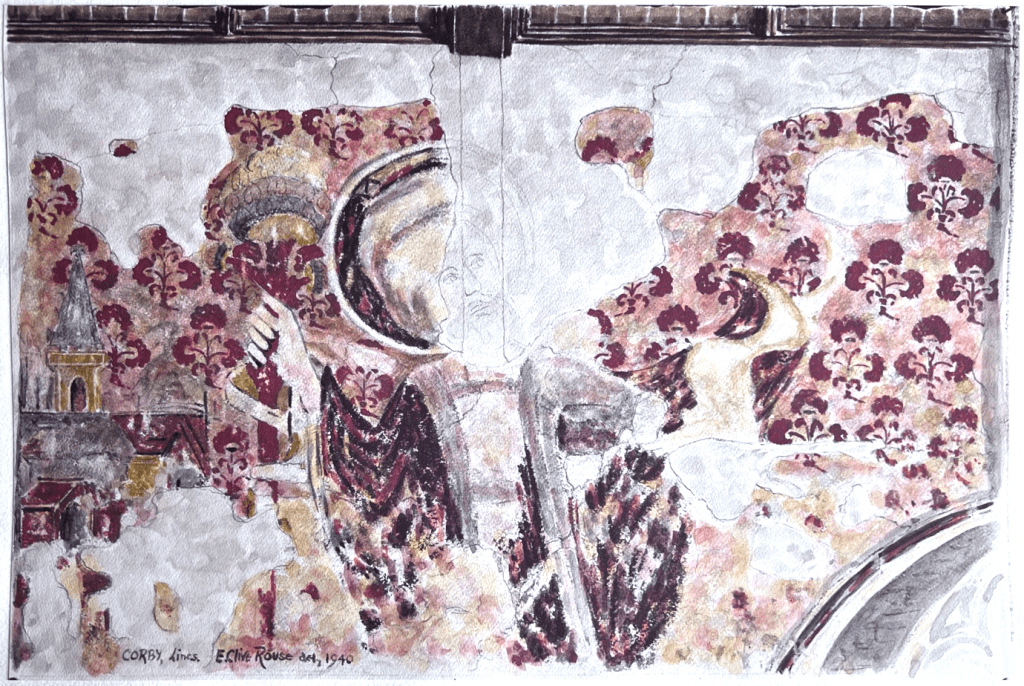
The Saint is of even more colossal proportions than the earlier painting. The large and elaborate halo is clear, also the hand grasping the top of the staff, shown as flowering in accordance with the legend. The drapery folds of the cloak remain, but the figure of the Child has perished. At the extreme left the Hermit’s cell is represented, with a little spire and porch.
Once again there is an elaborate background, this time consisting of a conventional branching tree or flower, and also painted with a stencil.
A morality: The Seven Deadly Sins, and a Warning to Swearers
On the other side of the window is perhaps the most interesting and remarkable subject in the church. On the wall it is somewhat confused by being partly on top of the earlier St Christopher; but the drawing, in which it is separated, will make it more clearly understood (Plate V).
In the centre is Our Lady of Pity – the Virgin, enthroned, holding the body of the dead Christ; and surrounding this are numerous groups of figures of young men in the height of the exaggerated fashions of the early 15th century, each accompanied by a devil. The whole is set on an elaborate brocade-pattern background in which the artist has used the same stencil as in the Weighing of Souls, but has placed the lower parts differently so as to vary the design, moreover painting these in blue-grey and adding a black star in the apex. The work is fragmentary toward the bottom, where it was merely carried over the older painting on whitewash, and was, moreover, mutilated by a monument, now removed.
The subject resembles very closely the arrangement of a stained glass window, now destroyed but fortunately recorded, at Heydon, Norfolk, and a wall painting, also perished, at Walsham-le-Willows, Suffolk.
It will be noted that above each figure is a scroll issuing from the mouth. The inscriptions on these are illegible except for a few letters: one ends “…ones” and probably read “By Goddes Bones”. But in the other examples each contained an oath on some part of Our Lord’s body, and the scroll beneath the Virgin and Christ contained a lament of the Mother over her Son – this also appears at Corby. It was inscribed “the cursed sweareres, albeit his limbes be rent assundered”. At Broughton, Bucks, the same subject is portrayed [https://reeddesign.co.uk/paintedchurch/broughton-swearers.htm]; in this case Our Lord’s body is mutilated and the youths hold portions of it.
The vice of swearing in this way was very prevalent in the late 14th and early 15th century, and is alluded to by Langland, Chaucer and other contemporary writers. It is not possible to see whether Our Lord’s body is mutilated in this case; but the teaching of the painting is clear – it is a warning to swearers and blasphemers that be so doing they re-crucify Christ and add to Our Lady’s woes.
In this case, the matter goes further: for the introduction of the devils does not occur in any of the other three similar examples in England. It will be seen that there are seven of them: and in two of the scenes two figures occur. We thus have combined with the Warning to Swearers (itself an unusual and interesting subject) a most unusual treatment of the Seven Deadly Sins.
It is not possible to identify them all. The one on the top right hand, where the devil is between two youths, is probably Anger (Ira) the devil inciting them to fight; while the first on the left in the middle row is Lust or Lechery (Luxuria), the nude female temptress riding off on a devil horse. The swords piercing the side and feet of two youths are references to the wounds in the side and feet of Christ. Note how one devil has a youth by the toe of one of his absurdly long pointed shoes. Note also the extravagant fashions of parti-coloured doublets and hose, three styles of fancy hood, hairdressing, long sleeves and so on – all points mentioned in Chaucer’s discourse on the Seven Deadly Sins in the Parson’s Tale.
The little image-niche of the early 14th century was filled up and plastered over at this period; now cleared, it shows its original outline in colour bands, and on the back and sides.
The south aisle
Very fragmentary portions only remain of the painting in the south aisle. There was evidence of painting of various dates throughout its length; but the plaster was so perished and the subjects further mutilated by the insertion of monuments and corbels that only two small areas justified preservation. These are both at the east end.
An early scroll fragment and border
Here the earliest work is apparently contemporary with the earliest subjects in the north aisle or perhaps before, c. 1300. It consists of a beautiful and very delicate black vine-leaf and tendril scroll on a pinkish buff ground, with a border of lozenge diaper enclosing angular quatrefoils in deep red and pink. It is most unfortunate that only a small fragment of this survives (Plate VI).
A Jesse Tree
Owing to settlements in the masonry, building alterations and other causes, the plaster in this corner was in a very bad condition, and there were no fewer than five layers of painting superimposed, all mostly fragmentary. The best-preserved subject is that which succeeded the early scroll period, and was painted about 1380–80, the only fragment of painting of this date in the church. It is a Tree of Jesse, or the Ancestry of Christ, far less commonly met with in wall painting than in glass (Plate VII). In the accompanying copy the painting of other periods has been omitted so as to make the important subject clearer.
In early examples like that at Chalfont St Giles, Bucks, the tree is shown with a central stem, and scroll-like branches on which stand Kings and Prophets, David as usual being prominent. At Corby the method of presentation is well developed, and is more akin to the example in the chancel at Chalgrove, Oxon and in the numerous instances of stained glass and window tracery, as at Dorchester, Oxon, Leverington, Cambs, etc.
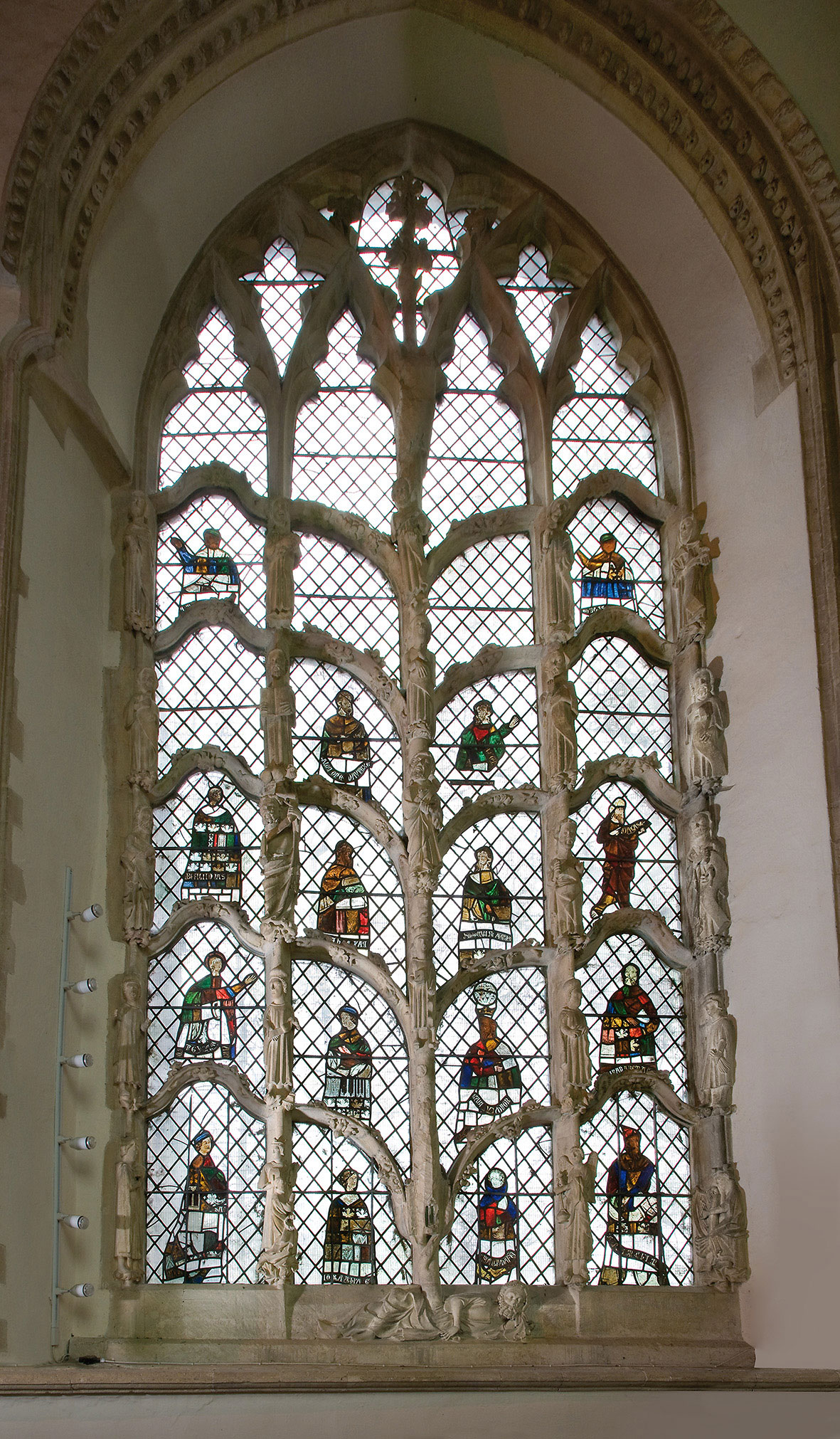
Jesse was lying at the base (now mutilated by the re-insertion of the piscina), and from his body spring the branches of the tree which interlace regularly in a formal way to make a kind of trellis, in each compartment of which stood a figure amid foliage on a crimson background, holding a scroll or symbol to show his identity. Though very fragmentary, remains of several scrolls and three figures remain. The work is of a very high order with beautiful detail and rich colouring, the foliage being in bright green with pink and chocolate buds, the stems being yellow outlined with deep red. When complete it much have been one of the most beautiful things in the church. It is continued on the east wall and on the jambs and soffit of the east window of the aisle.
A donor’s inscription
On the south wall, below the more easterly mural tablet, is an interesting fragment, having remains of a donor’s inscription, “ORATA P ANIA” (“Orate pro anima”, Pray for the soul of …), with traces of the bottom folds of the kneeling figure’s robes. The colouring is very rich, and seems to be connected with the last subject on the other side of the window, which was
apparently cut through it in the early 15th century (Plate VIII).
The nave
Finally we come to the great scheme in the nave, executed by the same artist or artists as the later scheme in the north aisle, c.1400 or soon after. Here we have no complication of several periods overlapping, or confusing backgrounds; but have a rare instance of an early 15th century rebuilding scheme with the whole of its accompanying painted decoration almost complete.
The Doom or Last Judgement
Above the chancel arch, and overlapping on the north and south return walls of the clerestory, in the usual position, is a great representation of the Doom, or Last Judgement. Though much mutilated on account of settlements in the wall and the perished condition of the plaster, enough remains to follow the setting out of the whole composition (Plate IX).
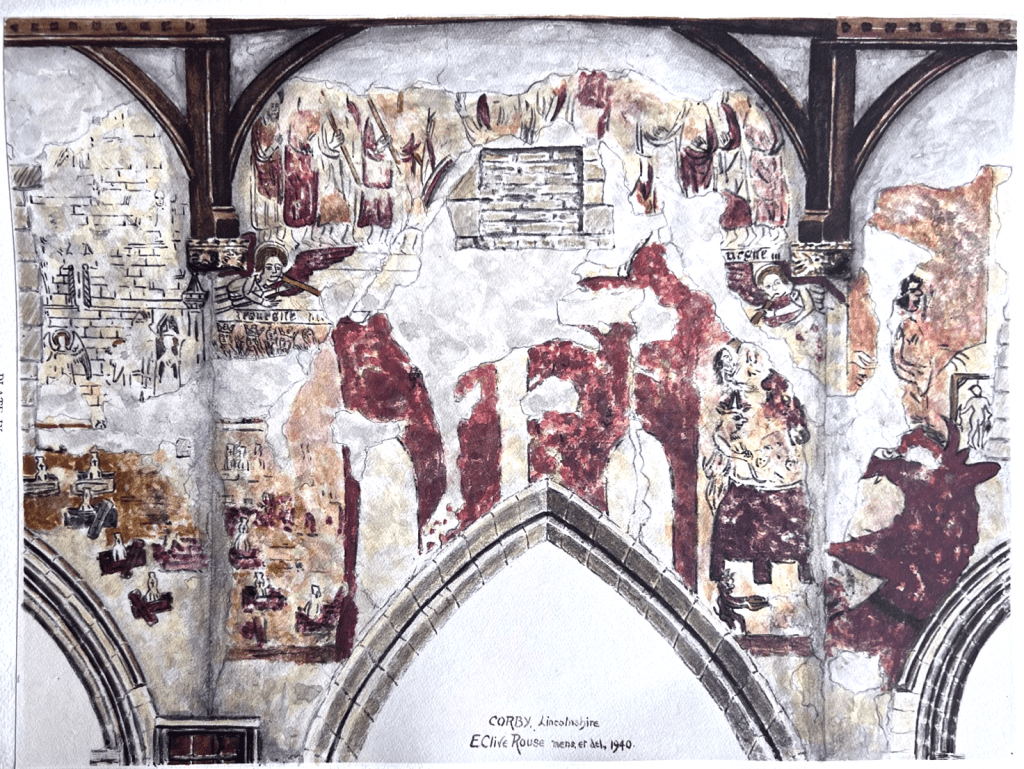
In the centre at the top, where the blocked window is now exposed, was Christ in Majesty seated on a rainbow judging the quick and the dead. One side of the rainbow remains and the right hand upraised, and portions of drapery. This figure was flanked by a group of Apostles on each side, all barefoot and some carrying symbols.
In the zone below this are two flying Angels near each corbel, sounding a literal “last Trump”, with scrolls inscribed “Resurgie Mortui”. Below the Angel on the north side is a group of resurrected souls, headed by Kings and Queens, about to received into the Heavenly Jerusalem by St Peter, shown on the north wall as masonry buildings with towers and gates with Angels at intervals.
Below this, on the east and north walls, is the General Resurrection, with souls in shrouds with a cross on the front of the face emerging and pushing back the lids of coffins.
On the other side are traces of other souls awaiting the Torments of the Damned. A demon in a pointed cap stirs souls into a cauldron, while a diminutive devil fans the flames with a pair of bellows beneath. On the south return wall is the Mouth of Hell, shown, as usual, as the open jaws of a great eared and horned monster with a baleful eye. Above is an engaging little scene of yet another demon stringing up a figure on a gallows. The figure holds a duck in one hand and another bird in the other, perhaps a playful warning to the local poachers.
The central section of the east wall served as a plain red background, with perhaps some black diaper or brocade pattern, for the carved wooden figures of the rood group. These stood on top of the rood beam or loft, and the blank spaces purposely left unpainted, in front of which stood the Crucifix and the figures of Saints Mary (north) and John (south), are plainly visible.
The Nativity story
The spaces between the clerestory windows in the spandrels above the nave arcades are occupied by a series of life-size single figures, telling in most original and striking manner the story of the Nativity, with the Annunciation to the Shepherds and the Adoration of the Magi (Plates X and XI). It should be stated that two figures out of the scheme are missing in the western-most bay on each side. They were a shepherd and a king, and there were traces of their existence; but they were so fragmentary owing to damaged plaster caused by extensive tower repairs in 1926 that they could not be left exposed.
The Shepherds
Commencing at the west end on the south side, the first shepherd is absent as stated. Next comes an old man with beard, bare-headed and clad in a long gown of deep red. He has a russet cloak with cape-like sleeves of grey, probably intended to represent lamb- or goat-skin; and a hood that is thrown back. He carries his crook over his left shoulder with a lamp hanging from it, having apparently a floating wick. He points up at the star or the apparition of the Angel with his right hand. His flock is around and beneath him – some appear to be goats.
His companion shepherd is a young man with parti-coloured belted tunic and hose in grey-blue and red, ankle boots, and a grey shoulder-cape with scalloped edge and pointed hood worn over the head. He likewise points upwards with one hand and carries his crook and lamp in the other, but wears in addition a gauntlet glove. He also has his flock, a ram and two sheep, one looking round at his, and in addition the sheepdog (a kind of talbot) and the shepherd boy playing a pip appear.
King Herod
Appropriately next door to the Mouth of Hell is portrayed King Herod, sitting cross-legged on an elaborate throne in brown and black. He wears a very short red tunic with ermine hem and tippet, and his trunk hose are red and white. Note the enormously long shoes with little ornament at the end. He has on a kind of Eastern tiara, and carries a great curved scimitar or falchion over his right shoulder, the other hand being open in judgement, clearly intended to suggest the ordering of the Massacre of the Innocents.
The Magi with their gifts
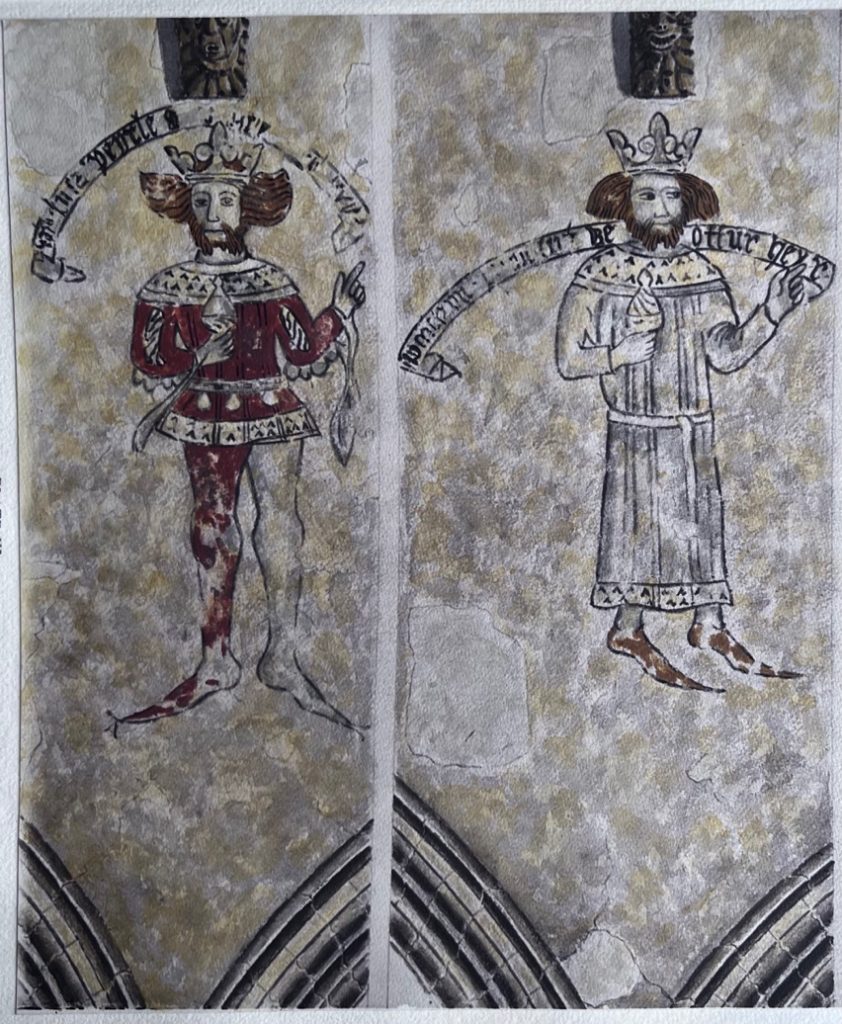
Returning to the west end and crossing to the other side, the first of the three Magi is destroyed. The next is most sumptuously and elaborately clad in very brief doublet or tunic of brown, with ornamental belt, and hem and tippet of ermine, the sleeves slashed, and having scalloped or dagged hanging undersides. The trunk hose are brown and white. He grasps a covered cup in one hand and points with the other to a scroll inscription above him. Note the swept-up coiffure.
The other king is more simply habited in a long, white, sleeved gown of ankle length, girdled, and with ermine hem and tippet. His shoes are yellow, and long and pointed like the others. His attitude is similar, and a few words can be read on his scroll “… we offur heyr”. His coiffure is rather shaggy and hangs down – note the fashionable forked beards.
The Virgin and Child
The scheme culminates in a charming representation of the Virgin and Child enthroned. Our Lady has a close-fitting bodice and gown of pinky-red, and an ermine-lined cloak. She holds a little sceptre with fleur-de-lys finial in one hand, and supports the Child (in a red gown striped with black), his hand raised in blessing, on her knee.
At one side of the throne are remains of a fragmentary figure, perhaps St Joseph; while on the other is the unbelieving midwife; and below, the ox and the ass feeding out of the manger. All of these figures would have been familiar to the congregation from the Miracle Plays they would have seen in the big towns.
Post-Reformation painting
16th and 17th century texts
As has already been stated, the medieval work was covered at the Reformation with whitewash, upon which texts of scripture (“sentencing”) were painted, often in elaborate frames of strapwork ornament. There are some remains of these, notably the Lord’s Prayer may be seen above the earlier paintings; and over the south door, where there is a small patch exhibiting two periods, late 16th or 17th century superimposed. In the north aisle is a small piece of an elaborate frame. Texts covered most of the other paintings, but these naturally had to be removed to expose the medieval work.
The whole interior of Corby Church now provides a most valuable example of the English medieval painting and the teaching of the Church.